BibTeX to IEEE Converter
Paste BibTeX entries and copy a numbered IEEE reference list, with a table of the number for each citation key.
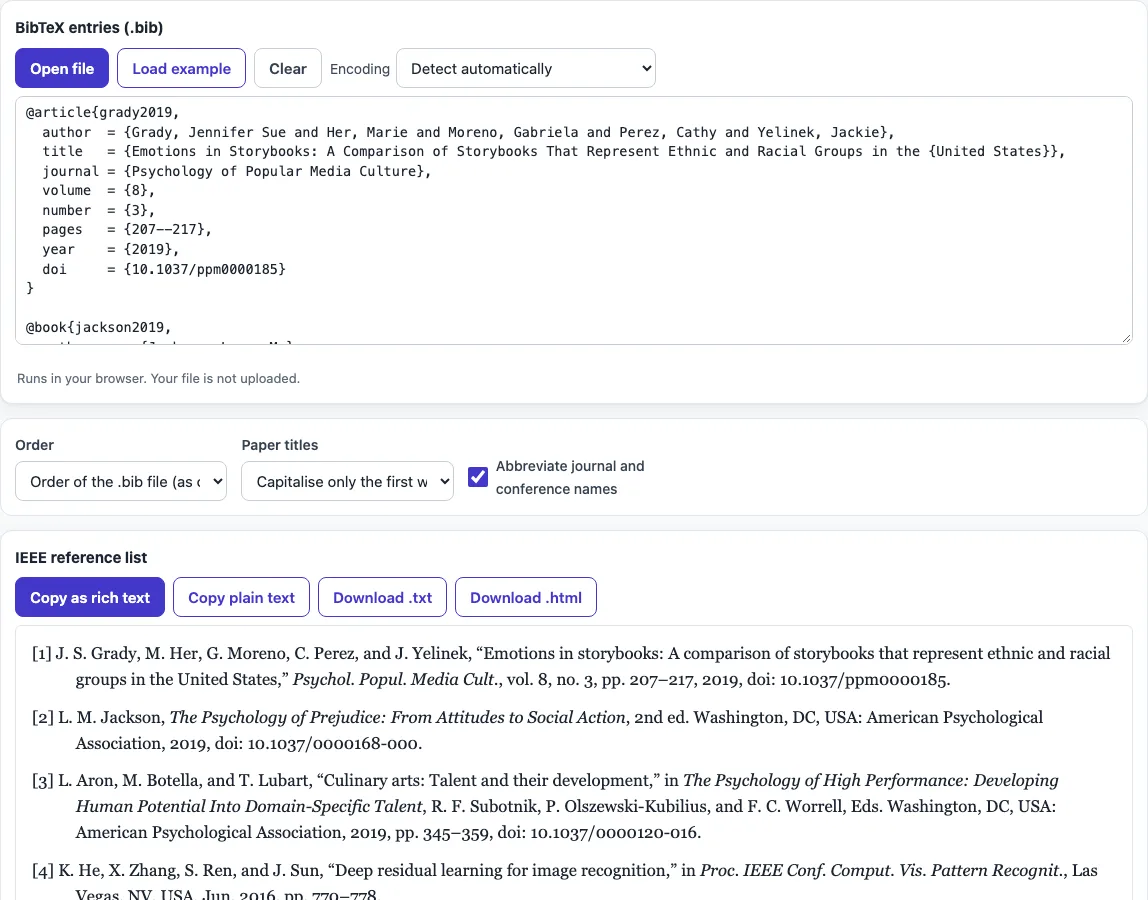
How to use the BibTeX to IEEE converter
- Paste one or more BibTeX entries into the input box, or open a .bib file from your device. The tool reads @article, @book, @inproceedings and the other entry types.
- Look at the formatted list. It updates as you type or change an option.
- If an entry cannot be read, the tool reports it with its line number and still formats the rest. Fix the flagged entry and the list updates.
- Set Order. Choose the order of the .bib file (as cited) or alphabetical. IEEE numbers references in the order they are first cited, so use the as-cited order for a paper.
- Set Paper titles. Choose “Capitalise only the first word (IEEE rule)” or keep the titles as written.
- Set Abbreviate journal and conference names if you want IEEE abbreviations such as Proc. and Int.
- Copy or download the result. Use Copy as rich text to keep italics when pasting into Word or Google Docs, Copy plain text, Download .txt or Download .html. Use the table to match each citation key to its number.
Option choices are kept in the page address, so a bookmarked or shared link reopens the tool with the same settings. Your text is never put in the address. The output may be used for any purpose, with no attribution needed.
How do I convert BibTeX to IEEE style?
Paste your BibTeX entries into the tool and it turns each one into an IEEE reference, numbered [1], [2] and so on. This is the BibTeX to IEEE format conversion, and it applies the IEEE Reference Guide rules to each field of each entry.
The tool also cleans up the text. LaTeX such as {"o} becomes ö, \& becomes &, and – becomes an en dash. Words in braces, such as {United States}, keep their capitals. Macros, month names (jan to dec) and # joins are handled too.
How are authors written in IEEE references?
Initials come before the surname, and “and” comes before the last author. For example, Jane Smith, Ali Khan and Maria Lopez becomes J. Smith, A. Khan, and M. Lopez. When a reference has more than six authors, list only the first author followed by “et al.”
The tool reads names the BibTeX way: ‘Last, First’, ‘First Last’ and ‘von Last, Jr, First’. An organisation written in double braces, such as {World Health Organization}, stays whole.
How are references numbered in IEEE?
IEEE numbers references in square brackets in the order they are first cited in the text, so the first source you cite is [1]. Each source keeps its number wherever it appears again.
The Order option lists references in the order of your .bib file or alphabetically. For a paper, choose the as-cited order to match IEEE numbering. The table beside the list shows the number for each citation key, so you can match in-text citations to entries.
How are journal names abbreviated in IEEE?
Journal and conference names are set in italics and shortened using standard words. For example, Proceedings becomes Proc., International becomes Int., Conference becomes Conf. and Computer Vision becomes Comput. Vis.
The Abbreviate journal and conference names option uses a built-in list of common words. Unusual titles may not be covered, so check them against the publisher’s list before you submit.
Frequently asked questions
Is BibTeX to IEEE conversion free?
Yes. The tool is free, and you do not need an account or sign-up.
Can I use the IEEE references in a published paper?
Yes. The output may be used for any purpose, including published papers and commercial work, with no attribution required.
Does my BibTeX text get uploaded?
No. The tool runs in your web browser, so what you paste or open is processed on your own device and nothing is uploaded.
What happens if one BibTeX entry has an error?
The parser reports the entry it cannot read, with its line number, and still formats the other entries. Fix the flagged entry and the list updates.
Do I need this tool if I write in LaTeX?
Usually not. With \bibliographystyle{IEEEtran}, LaTeX produces the IEEE format automatically. This tool is most useful for documents written outside LaTeX or for checking entries.
Are the abbreviations official?
The tool uses a built-in list of common abbreviation words (Proc., Int., Conf., J., Trans. and others). Journals have official abbreviations, so check unusual titles against the publisher’s list before you submit.
Can I sort the list alphabetically?
Yes, set Order to alphabetical; the numbers then follow the alphabetical order instead of the citation order.
Related tools
- LaTeX table generator: use it to build tables for a LaTeX document.
- LaTeX equation editor: use it to write and check equations before adding them to a document.
- BibTeX generator: use it to create BibTeX entries when you do not have them yet.
- BibTeX formatter: use it to tidy up the layout of a .bib file.
- BibTeX to APA: use it when your publisher or course asks for APA style instead of IEEE.
- BibTeX to MLA: use it when your work needs MLA style.