Greek Letters in LaTeX
Every Greek letter's LaTeX command, uppercase and variant forms, with click-to-copy and a converter for Greek text.
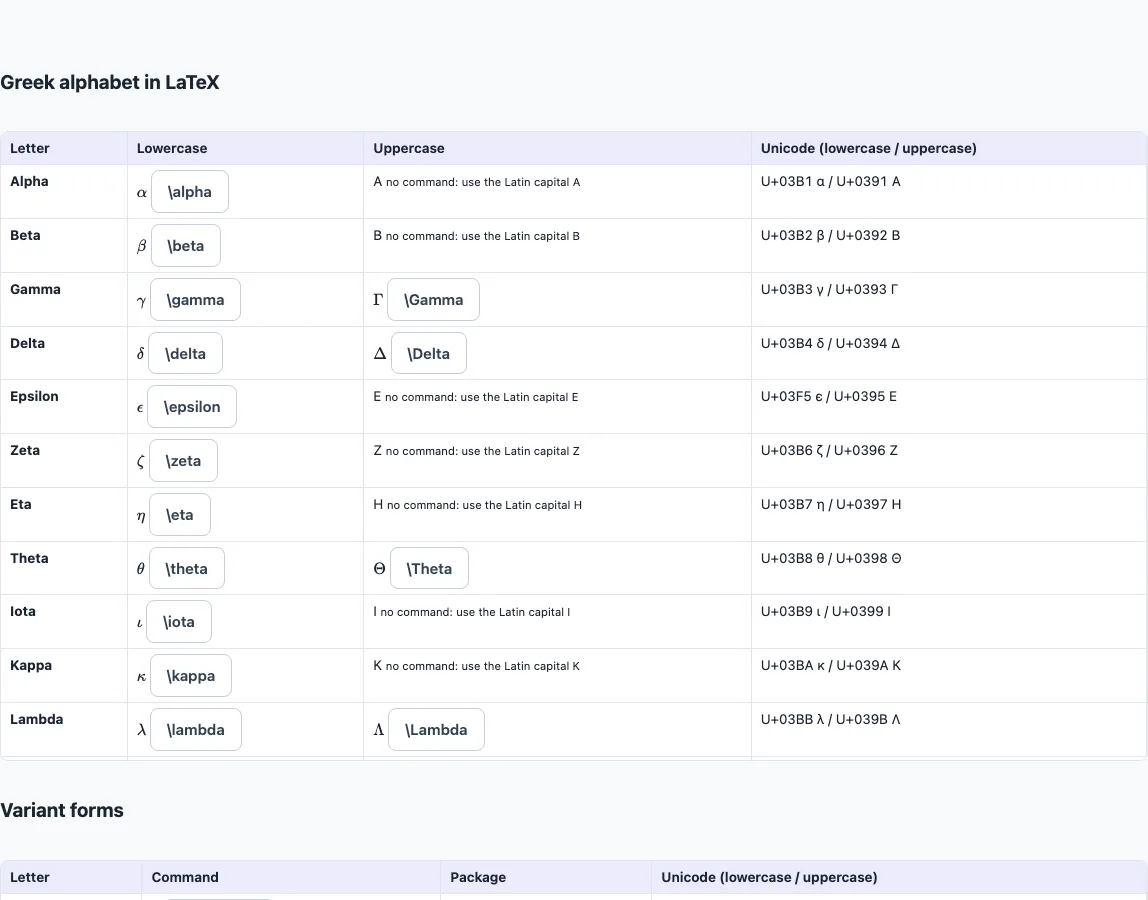
This page gives you the full Greek alphabet in LaTeX. It lists all 24 letters with their lowercase commands (\alpha through \omega), the uppercase command where one exists, the rendered glyph, and the Unicode code point, and you can click any entry to copy it. A converter also turns Greek characters such as α and Σ into LaTeX commands, and it works in reverse too.
The tool runs entirely in your web browser, so your text is processed on your own device. It is free, and no account or sign-up is needed. Use it when you need the exact command for a symbol, such as \alpha for α, or when you want to check a command’s spelling before pasting it into a document.
How to use the Greek letters tool
- Scroll to the alphabet table. Each row shows a letter’s lowercase command, its uppercase command if one exists, the rendered glyph, and the Unicode code point.
- Click the command you need. It is copied to your clipboard.
- Paste it into your LaTeX file inside math mode, for example
$\alpha$. Greek commands do not work as plain text. - To convert existing characters, open the converter set to “Greek characters to LaTeX commands.” Type or paste text such as α, β, Σ. The result updates as you type.
- Turn on “Wrap each command in
$ $” if you want the output ready for math mode, so α becomes$\alpha$. - Turn on “Use Latin letters for capitals that have no command” if you want Alpha written as A, not as a command that does not exist.
- Switch the converter to “LaTeX commands to Greek characters” to reverse the process. It accepts
\upalphaas input.
Your option choices are saved in the page address. A bookmarked or shared link reopens the tool with the same settings. Your text is never placed in the address.
The variant forms have their own table below the alphabet, with the package each one needs. Copying a command copies only the command, so paste it inside math mode in your document.
Why is there no \Alpha command in LaTeX?
Uppercase Greek letters that look exactly like Latin capitals do not have their own LaTeX commands. Alpha, Beta, Epsilon, Zeta, Eta, Iota, Kappa, Mu, Nu, Omicron, Rho, Tau and Chi are written with the Latin capitals A, B, E, Z, H, I, K, M, N, O, P, T and X. Since the glyph is identical, a separate command would add nothing.
Lowercase omicron is simply o. The uppercase letters that look different from Latin capitals do have commands: \Gamma, \Delta, \Theta, \Lambda, \Xi, \Pi, \Sigma, \Upsilon, \Phi, \Psi and \Omega. If you type \Alpha, LaTeX will report an undefined control sequence, so use A instead.
What is the difference between \epsilon and \varepsilon?
\epsilon and \varepsilon are two shapes of the same letter. \epsilon produces the lunate form ϵ, and \varepsilon produces the curly form ε. Both represent epsilon, and the choice comes down to appearance.
The same pattern applies to \phi and \varphi. Other variant forms follow the same logic: \vartheta, \varpi, \varrho, \varsigma and \varkappa are alternate glyphs for theta, pi, rho, sigma and kappa. \varkappa needs the amssymb package. Pick the form that matches the style of the document, book or paper you are following, and use it consistently.
How do I write Greek letters in normal text?
The commands above are for math mode. In running text, write the letter inside dollar signs, such as $\mu$m, or, if your document is compiled with XeLaTeX or LuaLaTeX and a font that has Greek, type the Unicode character directly. With pdfLaTeX, the textgreek package provides text-mode commands such as \textalpha.
Most Greek capitals that do have a command are upright in math mode, while lowercase Greek is slanted. For slanted capitals use \varGamma, \varDelta and so on with the amsmath package.
Copy from the table to avoid typos such as \lamda instead of \lambda.
Frequently asked questions
How do I type Greek letters in LaTeX?
Write the command with a backslash in math mode, such as $\beta$ or $\Gamma$. Use the lowercase name for lowercase letters and the capitalized name only for the uppercase letters that have a command. For uppercase letters that look like Latin capitals, type the Latin letter.
How do I get upright Greek letters?
LaTeX sets Greek letters in math mode in a slanted style. For upright letters, such as units like µm or π used as a constant, load the upgreek package in your preamble and use commands such as \upalpha and \uppi.
What is the Unicode code point for α?
α is \alpha in LaTeX, and its Unicode code point is U+03B1. The table on this page lists the code point for every letter so you can match a character to its command.
Why does \varkappa give an error?
\varkappa is not part of the standard LaTeX set, so it needs the amssymb package. Add \usepackage{amssymb} to your preamble, then compile again.
Can I use the output in a published paper?
Yes. The output, including code, can be used for any purpose, including published papers and commercial work, with no attribution required.
Related tools
- LaTeX symbols: use this when you need operators, arrows or other symbols beyond the Greek alphabet.
- LaTeX equation editor: use this when you are building full equations that combine Greek letters with other notation.
- LaTeX fractions: use this when a Greek-letter expression needs a numerator and denominator.
- LaTeX matrix generator: use this when your Greek variables sit inside a matrix.
- LaTeX font size: use this when you need to change the size of text in your document.